The Real Cost of Fragmented Supply Chains
24 Feb, 2026




Every critical industry in the UK, including defence, energy, and transport, is now driven by complex, interconnected systems. These systems are getting smarter, faster, and more integrated. However, our collective capability to design, manage, and maintain them has not kept pace.
We are facing an engineering reality check. Not because there is a shortage of people, but because there is a shortage of systems thinkers.
The call for retraining is not just about plugging a skills gap. It is about addressing a fundamental capability gap that threatens the pace and success of national infrastructure, innovation, and security programmes.
A decade ago, engineering was still largely defined by discipline. Mechanical, electrical, and software engineers each operated within their own boundaries. Collaboration was coordinated, not embedded.
Now, the boundaries have blurred. Everything connects to everything else. A decision made in software architecture can ripple through to hardware integration, safety assurance, and lifecycle sustainability.
This is systems engineering in action. It is also where many organisations struggle because most of today’s workforce was trained for a world that no longer exists.
The result is engineers who understand parts of the puzzle, but not always how the puzzle fits together.
For years, the default response to the skills crisis has been simple: hire more people. But that approach is not working.
Systems engineers are not readily available on the open market. They are developed through exposure, mentoring, and iterative learning that blends theory with practice. Recruitment alone cannot solve a systems capability gap.
Retraining existing engineers is the only scalable and sustainable way to close it. It is about unlocking the potential already inside teams, the engineers who understand products, processes, and pain points better than anyone else.
With targeted retraining, a mechanical engineer can become a systems integrator. A project engineer can evolve into a systems architect. A capable specialist can become a cross-domain leader.
This is not just reskilling. It is transformation.
This is not a challenge that can be solved with a standard recruit, train, deploy model. Systems thinking is not a tick-box competency. It is a mindset shift.
Off the shelf training can teach systems theory, but it cannot instil the curiosity, critical thinking, or whole-system perspective needed to operate effectively in high-stakes environments. That takes experience, context, and guided learning that connects what engineers know with how they apply it in real-world complexity.
Retraining done right is immersive. It is collaborative. It is tied directly to live projects and measurable outcomes.
Retraining is not just a people initiative. It is a risk management strategy.
Critical projects increasingly depend on systems capability. Without it, organisations face escalating costs, missed milestones, and integration breakdowns that can ripple across entire supply chains.
Embedding retraining into workforce strategy strengthens project resilience, reduces dependency on hard-to-source specialists, and builds an internal pipeline of systems expertise that grows with the business.
This approach is not only smarter from a commercial standpoint, it is essential for maintaining operational integrity.
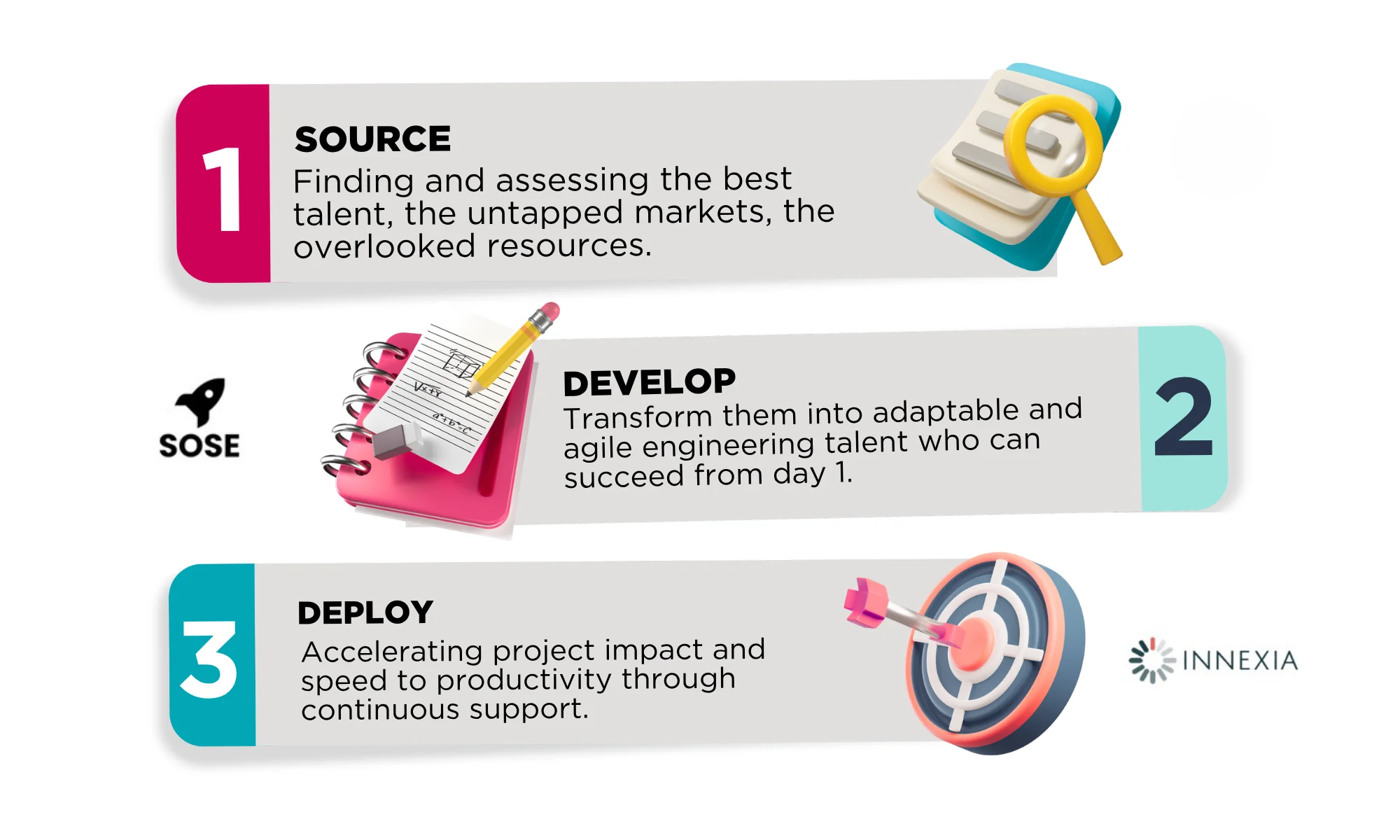
This is the thinking behind LEAP, a partnership between Matchtech, the School of Systems Engineering, and Innexia.
LEAP gives organisations a structured, scalable route to retraining existing engineers into systems roles. It blends academic rigour with real-world application to ensure participants do not just learn systems principles, they live them.
Through LEAP, engineers move through modular learning and live project work, supported by mentorship from industry practitioners and systems specialists. The outcome is not just a certificate. It is a demonstrable uplift in capability and confidence to lead complex systems projects.
LEAP helps businesses build their own systems engineering capability, one retrained engineer at a time.
Retraining does more than fill skills gaps. It changes culture.
When engineers start thinking systemically, silos begin to break down. Collaboration strengthens. Communication improves. Teams move from firefighting to foresight.
This cultural shift is where retraining delivers its deepest value. It is not just in skills gained, but in how engineers think, lead, and connect their work to the bigger picture.
In industries where every decision has a domino effect, that systems mindset is invaluable.
The engineering landscape is evolving faster than traditional workforce strategies can keep up. Artificial intelligence, automation, sustainability mandates, and digital transformation are reshaping how systems interact and perform.
Without a proactive approach to retraining, firms risk being locked out of major innovation and infrastructure opportunities. The longer the gap persists, the harder it becomes to bridge.
Retraining is not just urgent, it is unavoidable.
At Matchtech, we have always believed the future of engineering depends on how we invest in people. Recruitment can find capability, but retraining builds it.
The systems engineering challenge will not be solved by chasing scarce skills on the market. It will be solved by unlocking the talent that is already here, the engineers ready to evolve if given the chance.
Now is the moment to make that investment. The systems that shape our world cannot wait for us to catch up.